From the BBC see this article on Learning at Home, including their latest schedules for Primary and Secondary Lockdown Learning.
On television programmes for primary pupils are on CBBC between 09:00 and 12:00 each weekday and for secondary school pupils on BBC Two, between 13:00 and 15:00.
This coming week, commencing 18th January features Mathematics strongly, with three of the 13:00 slots including Maths and every afternoon at 14:00 we have Dr Hannah Fry.
BBC Lockdown Learning
This article including the schedule links has been added to this Maths at Home post.
This post can also be found on the Featured Posts Menu on the right hand side of this blog.
Chris McGrane – Starting Points Maths
Chris McGrane’s Starting Points Maths is highly recommended, note this announcement regarding these wonderful curriculum booklets. Several are already available, including the first Algebra booklet which looks excellent.
Tim Brzezinski – Angle Sketching by EstimationTim Brzezinski – Definite Integral Problem
I then found his recent extension, Open Middle: Definite Integral Problem (2) which should certainly keep everybody busy!
There is much to think about here, to investigate this what should we keep the same, what should we vary? I started playing around with Desmos to investigate further.
Open Middle Definite Integration Problem
A recent happy discovery, thanks to Jane Hart’s Top Tools for Learning 2020 is featured on the Ed100 list, the digital tools voted for by educators and students in colleges and universities, ilovepdf. ilovepdf is a free PDF convertor and editor, many tools are all in one place. I have not tried many of the tools yet but certainly have successfully and easily used the Merge and Compress functions several times and have been very impressed.
I note from the analysis that the tools predominately reflect the situation in higher and adult education, only a small proportion of votes came from schools. The lists certainly seem to reflect the unprecedented times we are currently living in.
David Millward – PowerPoints
Seeing PowerPoint right up there on the list, I have noted from my blog statistics that still popular downloads, years after I uploaded them are David Millward’s PowerPoint collection. In fact I can see from the comments that it was 2012 when I uploaded these!
Edexcel Sample AS Statistics PaperMike Hadden – A/AS Statistics Files
The resources include several illustrations for the Further Mathematicians also, including resources on Complex Numbers and Matrices.
Mike Hadden – A/AS Pure Files
Further recent updates:
Maths at Home is being regularly updated and checked. I have included Jack Brown’s extensive library of videos which is available on his website, TLMaths.com; these are excellent for independent study. Also added to this post is Oxford University’s Oxford Online Maths Club; the session from Thursday’s livestream is available on their YouTube channel.
Have you seen the details for Oxford University’s Oxford Online Maths Club? This is a new weekly maths livestream from the Mathematical Institute of Oxford University providing free super-curricular maths for ages 16-18.
The sessions start on 7th January at 16:30 UK time.
The content will include maths problems, puzzles, mini-lectures, and Q&A. The sessions are all free and require no sign-up. The livestreams will be available on YouTube indefinitely.
The sessions will be of particular interest to students who are about to start an undergraduate Mathematics (or joint honours) degree later this year, also for those who are thinking of applying later this year to start a Maths degree next year.
Full details are available here, and you can see what the session on 7th January will include on the YouTube channel.
Happy New Year! 2021 has a lot to make up for after 2020, so we're starting with a bang with the launch of the Oxford Online Maths Club, a new weekly maths livestream from @OxUniMaths providing free super-curricular maths for ages 16-18. Starts 7 January. https://t.co/fcBVFHlPvopic.twitter.com/SGwWnsQZ17
Having written several Maths At Home posts since the first school closures, I thought it would be useful to provide a compilation post for these resources. All resource links have been checked and new resources added.
Daily Lessons provides a closer look at the daily lessons from White Rose Maths. These lessons are available for Early Years through to Year 10.
Also – a wonderful complement to these resources we have Nicola Whiston’s amazing collections of Key Stage 3 Knowledge Organisers (see also Knowledge Organisers – Mathematics) which follow the White Rose Schemes of Learning. She is sharing the collection here, via Dropbox. These are really attractive and I think will appeal to students. For consolidation and review these are perfect.
From the Oak National Academy Online Classroom, an extensive collection of lessons is available. The lessons cover Primary and Secondary KS3 and KS4 for many subjects. For Maths, see KS3, KS4 Express Maths and KS4 Maths, note that various levels are available. These video lessons include activities for students.
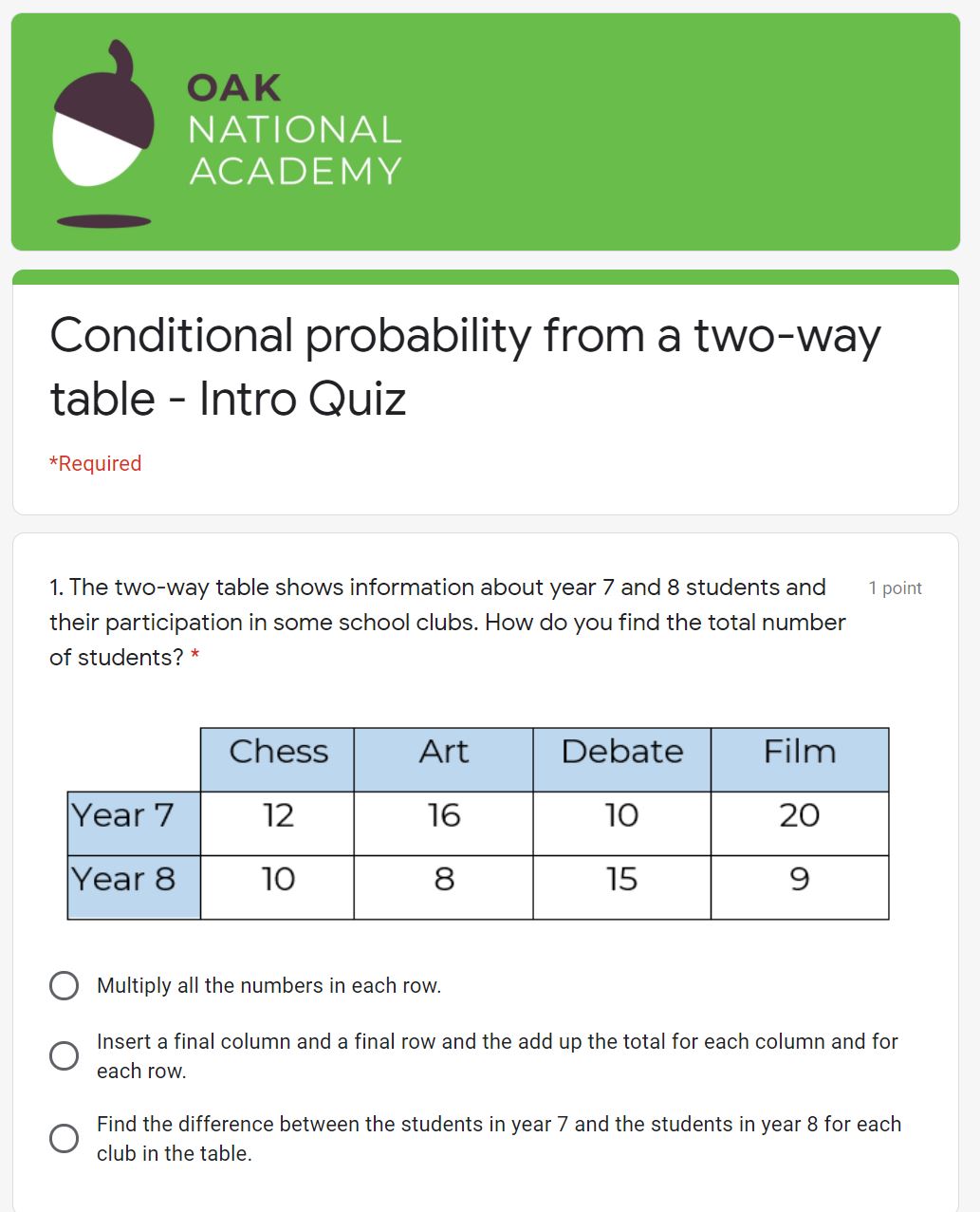
Oak National Academy Introductory Quiz
Looking at an Express Maths GCSE lesson, the introductory activity is a quiz. Feedback is provided where students submit incorrect responses.
From the BBC see this article on Learning at Home, including their latest schedules for Primary and Secondary Lockdown Learning.
On television programmes for primary pupils are on CBBC between 09:00 and 12:00 each weekday and for secondary school pupils on BBC Two, between 13:00 and 15:00.
From BBC Bitesize, home learning resources are available for Years 1 to 9. If we look at Year 7 Maths for example we see collections which include lessons with videos, activities and quizzes. Note the two week home learning packs, these include several of the excellent daily lessons published in 2020.
More Maths at Home – AMSP describes the excellent resources from AMSP which focus on target groups of students to support their progression from Year 10 to Year 13 (ages 14-18) and beyond.
AMSP
Note the menus for Students and Teachers at the top of the page which help you find appropriate resources. Choose the Student menu, then the appropriate option for the level of study.
Dr Frost Maths is of course used by millions round the world. Amongst the extensive library of resources are videos for students age 8-18 explaining topics from scratch. There are longer Exam-topic videos, average length 10 minutes and shorter Key Skill videos which are about 2-4 minutes in length.
Dr Frost Maths – Videos
Free lessons from Colin Hegarty recorded on YouTube are available to help GCSE students prepare for A Level Maths.
An extensive library of videos from Jack Brown is available on his website, TLMaths.com. Jack has created thousands of videos covering the complete A Level specification; note also the impressive Further Maths teaching videos and exam paper walkthroughs and a collection on bridging the gap between GCSE and A Level.
On MATHSHKO, Miss Konstantine has provided information and resources for remote teaching including some guides and remote lessons. The PowerPoints for re mote lessons look excellent and well worth exploring.
Pearson Edexcel GCSE Maths Lessons
From Pearson Edexcel comes a video collection of free GCSE Maths lessons. All around 50 minutes in length, there are 24 videos available.
From NCETM, we have lesson-planning and professional development resources for primary and secondary teachers. The resources include a set of Primary Video Lessons.
Mathematical Miscellany #41 includes Whiteboard.fi. You can read about the features here and follow News and Updates. There are now Basic and Premium plans but the free plan does allow a temporary whiteboard (2 hours) with a link provided so students can join; it is also possible to insert an image as shown below. See Pricing.
— Alison Clark-Wilson (@AliClarkWilson) May 13, 2020
Back to school at home… includes Home School Support from Maths Genie for students covering a range of abilities in three streams from Key Stage 3 (and high ability Key Stage 2) to high ability Key Stage 4.
This post also includes a reminder of Transum’s high quality, attractive resources. Given that there are an extensive number of self-marking exercises available, this can be a great source of activities for students to work on at home.
The Transum site is easy to navigate, there is a clear Topic Index for Teachers also, for students a Maths Map with numerous activities to support their learning.
Maths At Home – Nrich details some wonderful resources from Nrich who have published features for Primaryand Secondary. Both have numerous activities students can work on at home. The activities are categorised by age and within each collection you will find activities in various categories which are fully explained in the article for teachers.
Mathematical Miscellany #38 included a reminder of all the great resources on Jonathan Hall’s Mathsbot – there are so many activities which students can use whilst working at home; with answers provided for students to check, they are getting feedback as they work. Students could try for example Differentiated Questions or a topic ladder of their choice. A recent edition is the student version of Do Now.
Mathematical Miscellany #39 includes from STEM Learning, Home learning activities for families with resources to support primary students and for Secondary students, Maths, Science, Computing, DT and Post 16 resources are available.
Looking at Secondary Maths, we see a collection of games, activities and puzzles that can be used to support children’s mathematical education from home. This attractive calendar links to resources for each day of the term; follow the guide, or choose appropriate activities. No account is required for the home learning resources linked to on the Maths Calendar.
The Mathematics Department have written chapter booklets to accompany Dr Jamie Frost’s presentations. The booklets have been designed to be used by students to fill in whilst studying from the accompanying Dr Frost presentation. The resources have uploaded to TES, see this TES search; alternatively this Twitter thread has a link to each set of resources on TES (you don’t have to be a Twitter user to access the link).
Bring on the Maths was the first post written in the Maths At Home series and includes several resources for students working at home including Bring on the Maths,
On CIMTthere are interactive tutorials for Years 7, 8 and 9.
Mathsbox is a subscription (excellent value) site but
CK-12 Foundation has created a resource page with hand-picked lessons in math and science popular during the month of March.
ATM are providing some free resources at this time; note too ATM’s list of Activities for Home or School – suitable for Key Stages 2 to 5 – these have been suggested by ATM member and education consultant Mike Ollerton.
The resources for Key Stages 2, 3 and 4 include an extract with several problems with hints and suggestions from Forty Problems for the classroom.
A free resource for KS5 is a complete publication, The Proving Ground – an introduction to mathematical proof. This e-book offers forty easy to understand problems classified by one of three levels, level 3 has problems which have not been resolved. The book is very clearly structured, a notes page is provided for each problem, best accessed after trying the problem first. There are also Learning Pages which introduce different proof techniques. The home page is the contents page with links to all parts of the book.
From the introduction…
Hello, and welcome to this book, which offers you forty tricky, sometimes extremely tricky, mathematical problems to think about. Twenty of these have been resolved by mathematicians, sometimes after many years of work, but the other twenty at the moment remain unsolved, despite the attention of some seriously clever people down the years. Will you be able to spot the difference?
For any students going onto an Undergraduate degree in Mathematics or are thinking about doing so then Oxford University’s Oxford Online Maths Club (free) will be of interest. This is a new weekly maths livestream from the Mathematical Institute of Oxford University providing free super-curricular maths for ages 16-18.
The sessions start on 7th January at 16:30 UK time.
The content will include maths problems, puzzles, mini-lectures, and Q&A. The sessions are all free and require no sign-up. The livestreams will be available on YouTube indefinitely.
Full details are available here, and you can see what the session on 7th January will include on the YouTube channel.
Happy New Year! 2021 has a lot to make up for after 2020, so we're starting with a bang with the launch of the Oxford Online Maths Club, a new weekly maths livestream from @OxUniMaths providing free super-curricular maths for ages 16-18. Starts 7 January. https://t.co/fcBVFHlPvopic.twitter.com/SGwWnsQZ17