I couldn’t agree more with Siân, it’s always a pleasure listening to Simon Singh as it was listening to all the other great presentations at the February TM Maths Icons Conference. An amazing day – thank you so much @TMMathsIcons.
Not a conventional competition, but to challenge your able mathematicians, try Parallel from Simon Singh. All materials and resources are completely free and teachers will have access to all the student scores from the Parallelograms which are automatically marked.
Students earn points depending on their percentage score on each Parallelogram, which in turn earns mathematical badges. Even before you create an account Even without an account, you can get a taste of what we offer by just clicking on the Parallelograms on the left. Have a look at this parallelogram on Pie Charts and Speed Reading for example.
The Simpsons and Their Mathematical Secrets
The references to Simon’s book The Simpsons and Their Mathematical Secrets was a reminder of all the brilliant Maths hidden in The Simpsons. Information for teachers on the book is available, including a PowerPoint presentation for teachers Simon Singh has created, notes are given with the slides.
It was also a reminder that back in 2014 I was honoured to feature a post featuring answers by Simon Singh to my questions.
I enjoyed all the sessions, including Robert Southern on Graphical Transformations.
My own presentation was on the use of Colour in Mathematics and all the slides and some further links referenced in the slides are available on a dedicated page.
The puzzle at the beginning of the post which apparently Bart got before the rather more nerdy Lisa featured in the episode Lisa the Simpson.
The A Level course material from CIMT includes chapters on Discrete Mathematics. I have always found these a useful source of examples, several of which I have successfully used in class.
Each chapter includes very clear worked examples and exercises. Answers are included.
MathedUp – Mohammed Ladak
On Mohammed Ladak’s ‘MathedUp’ see his A Level Further Maths Takeaway, a wonderful source of exam questions by topic with mark schemes including very useful legacy AQA questions on Decision Maths.
MathedUp Challenges
OCR A and OCR B resources include their excellent Check In Tests, full worked solutions are provided. 10 varied questions are provided in each test covering AS and A Level and full worked solutions are provided.
OCRA – Linear Programming Check In Test AQA Topic Test Map extract – A Level Further Maths
A set of really useful Topic Tests are available for both Maths and Further Maths A Levels from AQA. I like the index provided by the mapping documents, one for Maths and one for Further Maths. For each test there is a clear statement of what is assessed in the test which comprises two sections. The questions in section A test basics of the topic and those in section B require a bit more thinking. Mark schemes are provided for all tests. (How to get access to AQA’s free portal – All About Maths).
Transum Mathematics – Linear ProgrammingSusan Whitehouse – Discrete resources
From Susan Whitehouse you will find will find a whole collection of Discrete resources as part of her resource collection. I do like her Multiple Choice resource with solutions in her Discrete / Revision and Tests section.
Preparing solutions I often use colour and highlighting in my explanations where I think this helps clarity. The following slideshow demonstrates the solution to a question on Dijkstra’s algorithm for finding shortest paths in network. I have changed colour once a new vertex has been chosen.
The Operational Research Society has a section on Teaching Resources, including some OR games which can be found on TES. A good excuse to play with some Lego perhaps!
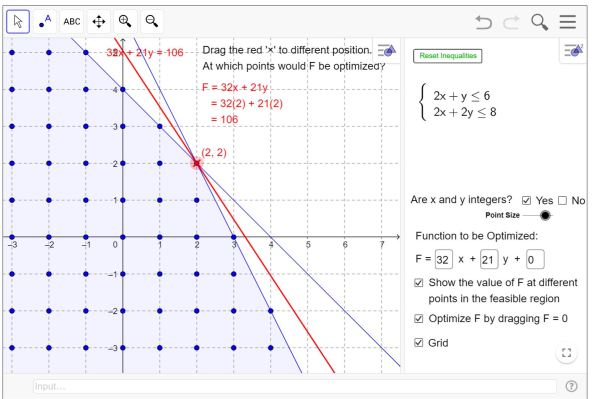
…and a rather good GeoGebra resource to illustrate the optimum solution. I like the way you can drag the objective function.
To finish on a light note, teachers of Decision Mathematics will be familiar with sorting algorithms which put elements in a list in order. A bubble sort is a sorting algorithm that works by working through the list to be sorted, comparing each pair of adjacent items and swapping them if they are in the wrong order. The pass through the list is repeated until no further swaps are necessary, the elements are then all in order having ‘bubbled’ to their correct positions.
CheckNathan Yau’s Flowing Data blog where he has embedded this video created by Sapientia University in Romania showing a bubble sort illustrated by a Hungarian folk dance.
Teaching sorting algorithms will never be quite the same again! If you look at the comments on Nathan’s blog some users have spotted errors but it certainly illustrates the comparison of adjacent pairs very well indeed.
We could also use Autograph. The web version of Autograph works very well for transformations. I find Autograph very intuitive for illustrating transformations. It is very simple to enter a shape and transform it. The shape can be a user defined so it is very easy to set up illustrations. It is also very simple to add labels. With Autograph when you select objects and then right-click you get a menu of appropriate choices, selecting an object and equation offers the option to reflect for example.
I have written on Transum many times, with its very clear Topic Index for Teachers also, for students a Maths Map with numerous activities to support their learning the site is very easy to navigate. The resources are very clear and attractively presented, they display well for demonstration in class as well as being very good for self-study for students.
Transum has activities for Transformations. I have found this activity which allows students to draw transformations online and have them checked particularly useful.
Transformations – Transum
Level 1 covers reflections, including reflecting in the lines y=x and y=-x, level 2, Translations, Level 3, rotations about the origin, and Level 4 Enlargement. For students studying Matrices and Transformations, Level 5 illustrates examples. Level 6 has some questions, we could easily illustrate the answers with Autograph.
There are of course many more resources available for Transformations, a selection…
Dr Austin Maths – Mixed Transformations Practice Grid
In January 2013 I published a first compilation type post on this blog, showing a collection of resources. The title of such posts changed over the course of some posts and it was in 2016 that I wrote Mathematical Miscellany #1, looking back I see over these early collections sites that no longer exist, or use Flash, or perhaps refer to earlier specifications. Correcting / updating material is an ongoing job and I’ll work on a good index for the resources which are still useful. I thought it would be interesting here to look at a small sample of resources which are still useful now.
OCR GCSE 9-1 Check in tests
In the very first Mathematical Miscellany post in 2016, I included OCR’s Check In tests. Full details of the Check in tests with suggestions for use can be found in the Teachers’ Guide. Each test is of a similar format in that Questions 1-5 cover procedural calculations (AO1), questions 6-8 require the ability to reason and communicate mathematically (AO2) and questions 9-10 relate to problem solving tasks (AO3). There is also an extension task.
These test are still excellent and just recently new tests have been added for GCSE and for Further Maths A Level. For GCSE we have Analysing data and Interpreting graphs. (Choose a qualification, then Planning and Teaching under Resource materials).
A site I have used for many years: Mudd Math Fun Facts. Try for example Squares Ending in 5 and Multiplication by 11both make excellent starters, we looked at proofs as well as enjoying the mental Maths tricks! You will find more mental arithmetic suggestions on the site. You can search by difficulty and subject.
Splat – Steve Wyborney
In 2017 a resource that caught my eye was Steve Wyborney’s Splat! Definitely a resource to explore further; you can read Steve’s blog post and download the lessons here.
Steve is clearly still very busy! Have a look at his recent resources. He is posting a new math resource every school day for the rest of the school year. You can read his plan. Also see this post on The 12 Most Popular Math Strategies and Downloads. I see the first is Splat!
New Esti-Mysteries and Number Sense Resources Every Day for the Rest of the School Year https://t.co/ydAGQWAWrw
Back in 2016, I first mentioned Gareth Westwater’s great resources (@westiesworkshop) and again some years later in Mathematical Miscellany #45 with a very welcome addition for Further Mathematics. All the past paper by topic PowerPoints are also now up on Westie’s Workshop; note that you can download the full PowerPoints as well as accessing individual sections. The PowerPoints are very clearly structured and use questions from past papers also from the sample assessment material. The resource can be used by pupils for self-study or worked through in class. For GCSE you can select AQA, Edexcel or OCR.
More updates are on the way. The video explains the very comprehensive Course Support section. This is really useful with so much in one handy place. Look at Integration for example discussed in the video and you will see that we have Dr Frost resources, Berwick Maths, Owen’s PowerPoints and much more.
Problem Solving is an open access (free) book which looks at research on Mathematical Problem Solving.
I read an article from Science Alertback in 2016 stating that Australian researchers have discovered that school children fare better at solving maths problems when they trace their fingers over practice examples, outperforming students who simply read the questions without touching them.
Well that’s certainly easy to try and in fact reminded me of my love of dot to dot as a child. Some years ago I created some polar curves for my students. Work out the correct order to join the dots and trace out those curves! (Join the dots 4 curves for the file in case anyone wants it).
You can easily create some graphs in dots on Desmos – here’s an example: