Have you seen the latest brilliant PhET simulation, Collision Lab?
…just experimenting with WordPress blocks!

| Click to Run |
Have you seen the latest brilliant PhET simulation, Collision Lab?
…just experimenting with WordPress blocks!
| Click to Run |
On Saint Patrick’s Day, (check Wolfram Alpha anniversaries and more for March 17th) it seems appropriate to remind readers about Project Maths, an Irish site supporting Mathematics teachers. Looking at the teacher area, many resources are available. Students normally sit the Junior Certificate exam at the age of 14 or 15, after 3 years of post-primary education and the traditional Leaving Certificate examination is the terminal examination of post-primary education and is taken when students are typically 17 or 18 years of age. These teacher resources are for this group of students. A site well worth exploring, looking at Algebra we see many excellent resources, including for example under expressions:

The student resources include many activities with accompanying GeoGebra files.


These whiteboard templates caught my eye, simply download the file, project it onto your whiteboard, use the interactive menu to choose the background you need and start writing!

Students normally sit the Junior Certificate exam at the age of 14 or 15, after 3 years of post-primary education and from the Graduate Recruitment Bureau A Level Equivalents Guide we see that An Irish Leaving Certificate is roughly equal to two-thirds of an A Level and is the main basis upon which places in universities, institutes of technology and colleges of education are allocated.
These qualifications with their very clear mark schemes provide us with another source of very useful examples. Once you have clicked the checkbox to verify that you have read, understood and accepted the terms and conditions, you can search for papers and mark schemes by subject. As well as marking notes, an excellent feature of these mark schemes is the model solutions provided.
For example, if we look at the Junior Certificate 2017 higher paper, question 6 is on Venn Diagrams; the mark scheme provides a model solution.
Looking at the 2017 Leaving Certificate paper, I see, for example, differentiation from first principles and De Moivre’s Theorem. Again, model solutions are provided as part of the mark scheme.
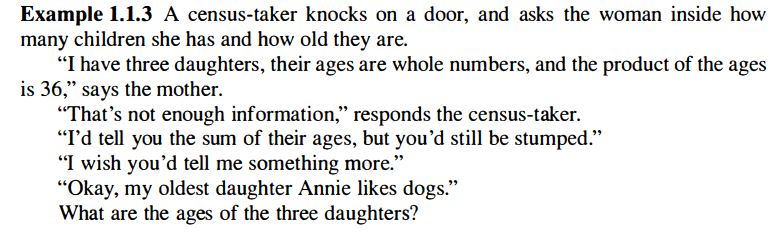
This post was inspired by Robert Euell’s excellent session on Problem Solving with Polya, at The Complete Mathematics Conference, #MathsConf25, March 2021.
Robert discussed teaching problem solving to students and looked at various problems, considering the steps in Polya’s problem solving process. One problem I had not come across before is the above census taker problem, a wonderful problem to illustrate the problem solving process.
This particular version can be seen in these sample pages from The Art and Craft of Problem Solving, the solution is presented here also.
Searching a little further I found further references to this problem and variations – some useful links:
From the University of California, Berkeley see this very useful summary of Polya’s problem-solving techniques – including a summary, in the Polya’s own words, on strategies for attacking problems in mathematics class from the book, How To Solve It, by George Polya, 2nd ed., Princeton University Press, 1957, ISBN 0-691-08097-6.paragraph
On mathinaction.org we see problems solving strategies, each is illustrated by various examples for younger students. Problems are suitable for younger students, grade 1 through 6.

Robert recommended websites that are excellent sources of problems including my own favourites, Underground Mathematics, Open Middle, Jonny Griffith’s RISPS and from The University of Waterloo’s Centre for Education in Mathematics and Computing; note the Problem of the Week and Problem of the Month.
Talking of Open Middle, I really like this from Tim Brzezinski on Building a distributive property expression. A lovely problem. Try this on GeoGebra.
I would add Nrich to the go-to list, see in particular this Starter Problem Selection, ideal for thinking about the problem-solving process as the problems have been chosen because they only make use of simple mathematical concepts, the emphasis in these problems is on thinking rather than knowledge. Also on Nrich you can search on Problem Solving, then filter your search by type, age and challenge level. Note their Guide to Problem Solving and for older students, the Advanced Problem Solving modules for STEP Preparation are excellent. And of course the UK Maths Challenges.

For more problems – try The Math Contest. Students from around the world can submit answers.
See Polya on Let us teach guessing.
And to finish … a final play on Mathigon…thinking about that census problem. So pleased I can embed Mathigon activities! This is more of an illustration than an activity.
From Craig Barton, look at his latest site, DQaDay.
Really get your students thinking about these questions, not just answering them correctly but thinking about the questions you can see in the image – can you explain the mistakes and how can you be convincing that the incorrect responses are incorrect.

You can search for questions in various ways including the clear tags. Each question very usefully shows the spread of answers on Diagnostic Questions, a link to the question and a link to the quiz from which the question is taken. Check Labelling right-angles triangles for example.
Looking for questions by topic I really like the Collections.
There is extensive help available on Diagnostic Questions including these Help Videos.
March 8th 2021 is International Women’s Day.
We’ll start with an image I have shared many times before that I think still says it all! Thank you, Steve Lomax (Photo courtesy of the wonderful children of Mansfield Green E-ACT Primary, @mgeact @EducationEACT) who shared this wonderful response to the task ‘Describe a mathematician’…

This year’s theme is #ChooseToChallenge.
To quote from their site…
IWD sees a number of MISSIONS to help forge a gender equal world.
Celebrating women’s achievements and increasing visibility, while calling out inequality, is key.
Note one of the missions, perhaps particularly relevant to educators is “To celebrate digital advancement and champion the women forging innovation through technology“.
It seems appropriate to mention the resources from the Advanced Mathematics Support Programme, Find ways to encourage girls to study Mathematics. Note the free resources here, including (for girls and boys!) Maths, Opening the door to your future, a leaflet which explores the post-16 maths qualifications available to students, to help them decide which one is best. There is a girls’ participation self-audit resource to review your strategy and identify aspects to develop.
Note too the 30 minute presentation, Why Study Maths, for students and parents/carers which is about the importance of studying maths post-GCSE. It outlines the options available, and provides compelling reasons for choosing to take an advanced maths qualification. Slides and speaker notes are available to download. These resources could be an excellent way of helping Mathematics Departments link curriculum learning to Careers, for all students, helping to meet the Gatsby Benchmark on this.
From amsp, we also have Where maths meets the world of work. The AMSP is working on videos, which showcase the maths in different careers; each video is paired with a resource for the classroom or for use online, so students can get a real taste of what the job may entail.
Some further useful references on women in Mathematics:
From Lucy Rycroft-Smith, see this wonderful collection of books about Maths by women. Lucy chose these 13 books last year, I like the way she has categorised the books, a book for the artist, for the rebel…. Brilliant – I bought several of those books!
And for some History
Finally I’m honoured to be with these fantastic women! Thank you to The Mathematical Association!