Mathematical Miscellany #61

Featuring…

From Matt Woodfine on Maths White Board revision cards and online tests are now available.


Looking at the latest newsletter from Chris Smith, (highly recommended), I see he mentions Stella’s Stunners, this is an excellent site, I featured it in my post on Proof, it has so many excellent resources.

Stella’s Stunners

Stella’s Stunners is a library of more than 700 Non-Routine Mathematics Problems for Middle and High School Students; these problems certainly encourage mathematical thinking. You can filter the problems to narrow your search and usefully create a pdf document of your chosen problems. Perhaps try Symbol Pushing or Logic. Try the Introductory Problem Set which consists of twenty problems designed to show you how to use the problem library. A comprehensive user guide is available.


I’ll be keeping my Advent and Christmas pages updated – here’s another to add from STEM Learning.


If you have just a few minutes, then why not try a Maths in a minute article from Plus Magazine. A recent article by Kate Stansfield is on Maths and music. If this is a subject that interests you and you have more minutes, you can find a whole collection of articles exploring Maths and Music. The article in the Maths in a minute series includes a discussion on why some pairs of notes sound “nice” to us.

We could hear some different intervals on WolframAlpha which will also give you the pitch difference between the two notes.

Additional information includes the frequencies of each note, you can also find related musical queries. I spent rather longer than a minute on this, particularly having discovered other Music examples on WolframAlpha! You can get information on songs and artists, audio waveforms, and musical instruments as well as Music Theory.

Maths in a minute reminded me of The Mathematical Moments site which features many downloadable pdfs, posters that show the role that Mathematics plays in Science, Technology and Human Culture. A short or more detailed version of each poster is available and a search is provided. This is included in my post on Posters.

Mathematical Moments - Sticking the Landing

Continuing with the theme of Maths in minutes, From Pearson Qualifications, try Tea Break Training, these short videos which offer targeted professional development training on teaching strategies, content areas and support for GCSE Maths.


If you are preparing students for STEP examinations, have a look at this webinar from Nrich which In this webinar Claire explains how STEP questions can be used to help students prepare for a University Maths degree and demonstrates the resources available on the STEP Support Programme. (maths.org/step). This has been added to the University Admissions Tests page which includes many resources for students aiming at high A level grades.

Mathematical Miscellany #60

Featuring…

Andy Lutwyche – Lazy Lionel series

In my Fill in the blanks post, I featured many excellent resources where students must completely partly worked examples including several from a favourite resource author, Andy Lutwyche. I mentioned some of Andy’s latest resources include his Lazy Lionel resources, Lionel does not show his working, so loses marks! Andy has added further to this collection. We also have Hasty Hazel and Methodical Mabel, these are so good and I’m sure can promote excellent conversations in the classroom on misconceptions and showing sufficient working.

See also Compare & Discuss/Multiple Strategies


White Rose Year 11 end of term assessments

From White Rose Maths, Year 11 end of term assessments for autumn are now available free from their secondary assessments page, scroll down for Autumn Foundation and Higher resources. Mark schemes are also provided.

Staying with White Rose Maths …

White Rose Maths – Barvember 2021

It’s still November, so remember Barvember, from White Rose Maths, which was created to encourage the use of the bar model. Now you can solve the problems using another great digital tool from White Rose Maths, Bar Model. White Rose Maths completed the solution to their day 10 challenge on the Bar Model tool:

Bar models can really help children visualise and then solve maths problems. See Bar Modelling.


NCETM Secondary Mastery Professional Development Materials – Operating on number

NCETM have published KS3 subject knowledge audits; there are 17 audit documents with each one based on one of the core concepts from the NCETM Secondary Mastery Professional Development Materials. For each document, following audit questions with check boxes you can select to show how confident you are, you will find exemplifications and explanations, and further support links. There is space at the end of each document where you can reflect on the material. Further KS3 teaching resources can be found on the 17 core concept webpages.


WolframAlpha

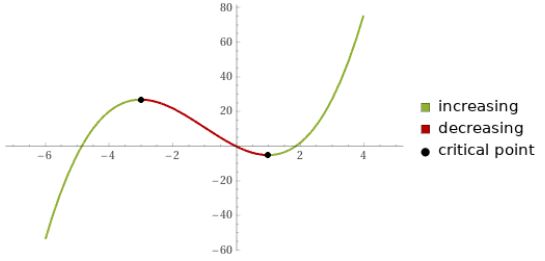
Discussing increasing and decreasing functions with my A level students recently I made the happy discovery that WolframAlpha provides a clear visual representation for such a query, as well as returning the values of x for which the function is increasing and decreasing; we also have the first derivative and critical points.


Since last week’s post on Literacy Skills in Mathematics, I have added resources to that collection. In my post on Proof, I began with the importance of spoken language. Spoken language is so important in students’ development, the KS3 Programme of Study quite rightly stresses the importance of spoken and written language. Both spoken and written language and notation are key. This applies to all key stages from definitions and examples and non-examples at key stage 3 to proof by contradiction – writing negations of statements at KS5. For many students, if their ability to write mathematics clearly and succinctly is poor this may well be a result of their not speaking about mathematics clearly. Conversations in class where students explain their thinking are so valuable.

Resources, where students practice writing expressions from algebraic statements and vice versa, are now included in the literacy post.

Also added are further Transum Mathematics resources as you can find a whole collection of Vocabulary activities on Transum.

Transum Mathematics – Circle Pairs

Mathematical Miscellany #59

Featuring…

Today is not only Halloween, it is Magic Day!

MathsPad Number Tricks

My post on Proof includes Magic or Number tricks which can be an ideal way into algebraic proof, try MathsPad – Number Tricks, one of the very generous collection of free resources on MathsPad (search on free), or be dramatic with Number Jumbler from Nrich! I have used this successfully with students from Year 7 to Year 12. Also try the suggested task, Double-Digit.

For a collection of mathemagical activities, try Transum Mathematics.

Transum Perfect Magic Square

You can find many activities on Transum, including Perfect Magic Square, which has 9 such puzzles, by the time we get to Puzzle 9 only two clues are given.


Wayne Chadburn – A little bit of maths each day

Tomorrow sees the start of November, so a good time to remind readers of Wayne Chadburn’s monthly calendars. He writes these calendars to provide regular, varied practice – a little bit of maths each day. In this academic year, he is producing calendars for year 11 students each month from September to April; the calendars for November 2021 are available. Note the three versions including crossover questions, Foundation, Foundation plus and Higher.

For November we have Barvember, from White Rose Maths, which was created to encourage the use of the bar model. Bar models can really help children visualise and then solve maths problems. See Bar Modelling.

Barvember – White Rose Maths


Nathan Day – factor Tree Puzzles

Back in July, Nathan Day published his very valuable CIMT Complete PDF. His website: Interwoven Maths Maths has all the brilliant tasks, displays, resources, and thoughts he has shared on Twitter over the past few years – a new treasure trove to explore! Try Factor Trees, for example, a set of (rather tricky) factor tree completion problems, that’s another lovely resource added to this Fill in the blanks collection.


For some quadratic questions to really get your students thinking, try these non-routine questions from @boss-maths. Follow the thread to the end for the answers!


Recovery Resources

Matt Woodfine continues to add to his brilliant site, a new addition is Level Up. a programme that targets basic numeracy.

From MEI, for KS3 have a look at these free GeoGebra interactive online classroom activities to support maths recovery at Key Stage 3. You can try the first three of five Algebra resources. Each lesson not only has a GeoGebra activity for use in the lesson, but also one for student independent learning. Full lesson plans and comprehensive notes for teachers are provided.

The collection will be expanded over the coming months to include similar sets of lessons for Number, Geometry and Measure, Ratio, and Statistics and Probability.

On the subject of GeoGebra, for the other end of the school, you will find on the Maths Emporium, a GeoGebra guide for A level Further Maths available to download or it is available with no login needed from the Edexcel website here. These activities have been produced to support teaching or could be used by students for independent study.

I have included many GeoGebra Resources on the GeoGebra series of pages. An extensive library of GeoGebra resources is available from Edexcel for GCSE (with many of these helpful for younger students also) and A Level.

Edexcel GeoGebra Resources

Edexcel GCSE GeoGebra Resources

Mathematical Miscellany #58

Featuring…

Following last week’s post on Mathematics for Psychology, note also these Desmos activities for Biology by Sarah Denison from AMSP/ASE Biology. My Mathematics for Science page has been updated with these Biology Resources.

Desmos Activities – Surface area to volume ratio, Sarah Desnison

As with the Psychology resources the Advanced Mathematics Support Programme [AMSP] are supporting Biology teachers of Psychology in their teaching of the maths and statistics requirements of the psychology specifications and provide free CPD and resources. Maths for Teachers of A Level Biology is an event starting on 30th November. The course is free to attend, priority is given to teachers from state-funded schools and colleges in England and trainee biology teachers. Full eligibility details as well as a detailed study schedule can be found on the AMSP site.


Seeing Jonathan Hall’s latest Mathsbot resource, Place Value and counting to 100, reminded me of a task that has been on my list for some time – an update to a resource list for Primary Mathematics, which now has its own page on the top level menu. This is still work in progress; more resources will be added in the coming weeks.


In case you missed this post – Compare & Discuss/Multiple Strategies

https://www.compareanddiscuss.com/

A new feature on Desmos – lists.


Seeing OCR’s latest puzzle, it struck me how ideal Autograph is for exploring this as plotting points and joining them with line segments is very straightforward. See the Autograph pages for more on Autograph.


On UK Exams and Assessments 2022, you can find updates from the exam boards including the formula sheets for GCSE Maths. For example, from AQA

Formula Sheets

Formula Sheets: Students will be given a formulae sheet in GCSE Maths and a revised equations sheet in GCSE Physics and GCSE Combined Science covering all the equations required in the subject content.
We will make these sheets available to schools for use in teaching and so students can familiarise themselves with them. They will also be provided in the exams. AQA

AQA have stated that everything in sections 1 and 2 of the appendix on pages 43-44 of the specification will be provided for the examination in 2022; anything required from section 3 will be given in the question as normal. You can view sections 1, 2 and 3 here.

Edexcel:

For GCSE Maths, the exam support will be a separate formula sheet which gives students the formulae they may need to refer to in their assessment, appropriate to their tier of entry. This will be available as an additional insert on the day of the examination. The formulae sheet will shortly be accessible via the website and learners should then familiarise themselves with the formulae sheet ahead of the summer 2022 examinations. Edexcel

OCR Update on the formulae sheet for GCSE (9-1) Maths assessments in 2022.

What impact will Ofqual’s chosen grading system in 2022 have

fft education datalab – 30 September 2021:
What impact will Ofqual’s chosen grading system in 2022 have?

Compare & Discuss/Multiple Strategies

Have you seen…this important resource for our teaching?

From researchers at Harvard University and Vanderbilt University, the Compare and Discuss Multiple Strategies (CDMS) routine, and the curriculum materials for algebra courses?

Explore the curriculum materials and learn how to use the resources. See the About page for a summary of the Create & Discuss/Multiple Strategies routine which it is suggested should take about 20 minutes.

See also “One way is the wrong way to do math. Here’s the right way.” from The Harvard Gazette

https://www.compareanddiscuss.com/

Within each resource, you will find questions that could be used for discussion of the example, a “think-pair-share” routine and a “Big Idea” page that summarises the lesson objective for the example.

The teacher’s guide also explains each of the four strategies.

Compare & Discuss/Multiple Strategies – from researchers at Harvard University and Vanderbilt University

As you can see from the image here you can filter the resources by Type, Lesson Use and Topic, within each topic you will find several subtopics.