A post from the archives this week, a reminder of the brilliant Mobile Puzzles.


The User Guide.

Recently published – a really clear user guide for Graspable Math.
I was delighted to see the announcement of the new user guide recently.
This can be downloaded from the Learn section of Graspable Math where you will see the Canvas User Guide. Together with the tutorial videos and Gesture Library resources there are excellent resources for learning Graspable Math.
All instructions are very clear in this 47 page document – everything you ever wanted to know how to do! Check the list of contents:


I checked how to insert a video and it struck me that you can insert a video on a canvas, watch it and try out the feature on the canvas. Try solving an equation on this canvas.
As a teacher, remember you can create a free Teacher account. Check out the Activity Bank with some great activities which will help you and your students learn Graspable Math.
I wrote recently about Graspable Math in this post which has proved very popular – where you will find more examples, including a couple of problems from Don Steward.
Remember that the Learn Section has Tutorial Videos, a Common Gestures Overview, and an Interactive Gesture library where you can watch then try gestures as well as the user guide. Look at this video on Scrubbing Numbers – a lovely feature enabling you to generate many examples.
A complete update to the Videos page, which is easily available from the top Menu.
All links have been checked and many new entries have been added.
For example, an important addition is Dr Frost’s Key Skills and Exam-Topic videos.
Mr Moreley Maths offers a comprehensive library of tutorial videos on GCSE Mathematics. A nice feature of this site is the accompanying Notes Jotter/Worksheet to make notes as you watch the video.

Another new entry and a site I certainly want to explore further comes from Mr Southern – Teaching and Learning resources for A Level. This site includes lesson plans, resources and videos.

The Videos page includes many collections for GCSE and A Level Maths and Further Maths.
A reminder for example of the excellent amsp videos.
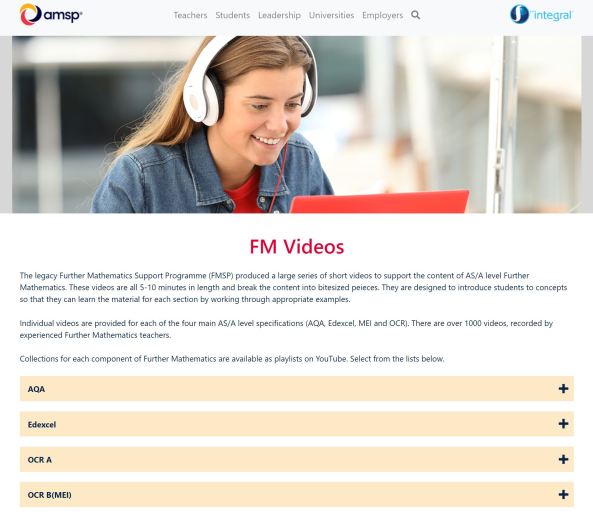
From amsp this brilliant collection of short videos produced by the legacy Further Mathematics Support Program supports the Further Maths Specification. I have used many of these successfully in class and recommended them to students to support their studies. Look at any of the examination boards to see the coverage for the course.
Also added are the free lessons from Colin Hegarty recorded on YouTube to help GCSE students prepare for A Level Maths.

At the beginning of a lesson, I like to get everybody busy straight away, making a calm start to the lesson and very much like the idea of so-called ‘bell’ work. Give students a task that is simple to understand and requires no more than a simple instruction, question/s and/or diagram on the board (no technology required – unless you are in the room ahead of your students which offers more possibilities). This is a particularly useful idea if students arrive at different times. Students are expected to get to work as soon as they enter the room.
In current times, the students may well be in the room before their teacher, so could be given instructions at the end of a lesson on what they are expected to be working on at the beginning of the next lesson.
Some ideas


Mental Tests
Many schools are providing students with booklets for use in lessons. Alternatively or in addition to, why not give a mental test where the teacher simply reads a short question which the students can write down and then answer can make an excellent start to a lesson, or in fact can be used at any point in a lesson. These should be very much low stakes activities. There are many sources of questions you can use, for example, see

Class Quizzes from Corbettmaths for a collection of questions designed to help students remember key facts. Looking at these will probably give you ideas for writing your own quizzes too.
A really useful source of questions which can be used this way are the mental tests from CIMT; these are included with their resources for Years 7, 8 and 9 and also for GCSE. For Key Stage 3 (ages 11-14) scroll down this page for the Year 7, Year 8 and Year 9 course material, the resources include mental tests as part of the teacher support material. On the GCSE page scroll down to the teacher support material and note the mental tests available for most units, see this on Formulae for example.


Talking of mental tests reminds me of a long forgotten resource I used to use with Year 7 – The Three Little Pigs as a mental test. I found this many years ago on MathsStories.com as a free sample.

Why not start a collection of such ideas? Many of these ideas could also be used for those odd moments in a lesson when you find you have some extra time.
A job I have been meaning to start for a while, a revisit to some of the much older Miscellany posts to remove any broken links and a reminder of the many excellent resources still available. This will be an ongoing project. For today a small selection of some enduring excellent resources from older posts.

From Fawn Nguyen comes the brilliant Visual patterns, note the menu; the Gallery includes blog posts from teachers and students who’ve used visual patterns in their classrooms.

For Problem Solving – GCSE Problem Solving Questions of the Day – Compilation from White Rose Maths available on TES Resources. The booklet contains over 50 problem solving questions suitable for KS3 and GCSE classes, answers are also provided. This resource along with other Problem of the Day resources is available from the White Rose Maths site.
Particularly excellent resources come from Andy Lutwyche, an author I have featured regularly on this blog; in fact looking back I see I recommended him as far back as 2012! Look at his excellent Erica’s Errors series for example and if we check on TES, these free resources also include plenty of errors from Clumsy Clive!


Mudd Math Fun Facts has resources which can make great starter activities, perhaps try Squares Ending in 5 and Multiplication by 11 both made excellent starters. I have looked at at proofs for these with students as well as enjoying the mental Maths tricks! You will find more lightening arithmetic suggestions on the site.
From the Science Museum, Mathematics in our World looks at how mathematics connects to so many aspects of our lives. Seeing the Spirograph, a favourite childhood toy reminds me of the brilliant digital version, Inspirograph by Nathan Friend. Try altering the gears so that the fixed and rotating gear are the same size, or make one size a factor of the other, make the two sizes have a common factor, or not! Investigate. You can change the colours too and create a work of Art!
More Spirograph resources.

I’ll end this week with a rather more recent resource, Forming Equations from Andy Lutwyche where students form equations from diagrams, the problems become more challenging but are accessible to a wide range of students.
