It’s Barvember from White Rose Maths. Barvember, from White Rose Maths, was created to encourage the use of the bar model. Bar models can really help children visualise and then solve maths problems. You could solve the problems using this great digital tool from White Rose Maths, Bar Model.
1/2 NEW RESOURCE: Bar modelling through the @WRMathsSec curriculum booklet for staff CPD – shows the progression of bar modelling through year 7 to 11 with examples for each topic in each year group and some video support #mathschat#mathscpdchat
The start of November is a good time to remind readers of Wayne Chadburn’s monthly calendars. He writes these calendars to provide regular, varied practice – a little bit of maths each day. Three versions of each monthly calendar are available, Higher, Foundation Plus, and Foundation; answers are provided.
GCSE Content 17. solve linear equations in one unknown algebraically (including those with the unknown on both sides of the equation); find approximate solutions using a graph
Desmos – Solve equations bar models Maths White Board
On Matt Woodfine’s Maths White Board, from the home page use the filter to choose Algebra and search on linear equations.
Math Whiteboard
On Math Whiteboard start a new board. On the right-hand side of the top menu select the three dots for More and then Highlight equivalence.
You can type expressions on a whiteboard and equivalent expressions will be highlighted in the same colour – brilliant. (For more on this feature – see Highlight Equivalence.
The ability to display or hide the variable and to take snapshots means working can be clearly shown using this PhET Sims Equality Explorer. Math HTML5 PhET sims by topic see PhET Sims – Index.
On the SERP website before see MathByExample and AlgebraByExample which is a set of Algebra 1 assignments that incorporate worked examples and prompt students to analyze and explain. These resources can provide prompts for discussing common misconceptions.
On Dr Frost Maths we can use any of the reosurces here on linear equations or perhaps try his full coverage resource – if you want a compilation of GCSE questions.
I think this ‘cover up’ method seen here on Don Steward’s Median can be helpful for many students, something I have used sometimes in class where students are finding solving equations challenging.
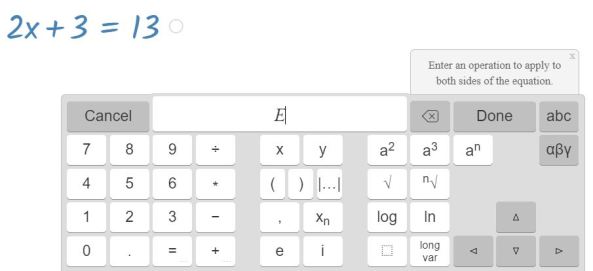
Graspable Math is easy to use, I decided I would solve an equation and wanted to show all the steps. To start, go to a blank canvas and choose Insert / Math Expression, I have used the method of selecting and holding the = sign to start as you can see illustrated in the video above; I was then able to enter an operation to apply to both sides of the equation.
Using my GCSE Algebra page which includes the GCSE subject content and resources, note also the sites easily searchable for algebra resources by topic. Several examples from these pages are given in this post for further resources from other sites on that list:
On my page on A Level worked examples, I highlighted the My Revision Notes books from Hodder. Many books are available in the My Revision Notes series, most with a free document of worked examples; questions and fully worked solutions for each section of the book are provided, whilst the documents refer to the books, they are complete in themselves. It’s good to see a book with this document for the International GCSE Mathematics from Pearson. I have added this to the IGCSE page.
Visnos Visual Numbers
Visnos Visual Numbers
A recent interesting online discussion recently on some students using only digital devices for telling the time made me wonder about resources for telling the time using a clock face. Looking at the KS2 programme of study, I see references to clocks, including tell and write the time to five minutes, including quarter past/to the hour and draw the hands on a clock face to show these times. Have a look at this demonstration, Time Angle and Fractions from Visnos Visual Numbers. I was happily distracted by many of the other demonstrations!
This has worked really well every time I have used it. The activity requires students to think about the methods which could be used to solve the various equations. I have always found that in addition to working on indices and logarithms this task has exposed some misconceptions, with students trying to invent some new and invalid laws of logarithms!
Students are often used to problems being posed in such a way that they have all the information that they require in order to start, and no more. Problems (especially from the real world) are very often not like this, and so resources of this type will give students the opportunity to develop the skills needed to deal with this. Some problems might not contain enough information, so students may need to decide on classifications, make assumptions or approximations, or do some research in order to move forward. Some problems might contain too much data, so that part of the challenge is to identify the useful information.
Another page with a new section is the A Level (16+) resources page from the A level series where I have added a section on sources of exam practice papers.
A reminder that MEI’s Ritangle competition begins on Monday. Do have a look at the questions from previous years (scroll down), full solutions are provided, these are a great source of questions for students studying A level Mathematics, the International Baccalaureate, Scottish Highers, or any qualifications with equivalent content.
Get the date in your diary, Ritangle returns on 3 October!@Integral_Maths's exciting competition for A level students is back, will you be this year's champion? 🏆 pic.twitter.com/4eYG4FhFyP
I really like the grids from Jonathan Hall on MathsBot, try his updated linear sequences grid. Note Jonathan’s reference to Amanda Austin’s brilliant Linear Sequences Fill In The Blanks activity. Remember you can keep an eye on new resources from Amanda Austin, I see a fill in the blanks circle geometry activity for Year 12. For lots more fill in the blanks activities from a variety of sources see this Fill in the blanks post.
Andy Lutwyche – Careless Casey
Talking of new resources, see Miscellany #63 which includes examples of sites with clear ‘What’s new?’ type sections or are easily searched for recent additions and/or have a subscription to a newsletter. Looking at the latest resources from Andy Lutwyche on TES I see Casey continues to be very careless with her Level 2 Further Maths!
DrFrostMaths is such a goto website and an excellent example of a website which is easy to navigate, perhaps try the Question Explorer. A brilliant feature (well one of the many brilliant features) of Dr Frost Maths is the extensive collection of key skills for UK KS2 to KS5 (ages 8-18), practice as many examples as you want, and perhaps watch a video on this key skill.
DrFrostMaths Key Skills
Note this latest work – diagrams for Key Skills are now done using Desmos.
From Mark Willis, try his Video site, a comprehensive set of Maths questions ordered according to topic and level with video solutions from KS3 to A-Level FM with interactive GeoGebra apps. Also available are IGCSE quizlets.
Five Ways To.. The Collection https://t.co/1uh909qmtO Now complete. 10 posts all linked here with downloadable one-page summaries by @MrGoodwin23. Share freely. Hope they're useful.