An annual job – I have checked and updated both my Maths Advent Calendar and Christmas Mathematics resources collections. Both collections are easily accessible from the Featured Posts menu on the right-hand side.
I will keep both collections updated as any new resources appear this year.
Corbett Maths – Revision ResourcesCorbett Maths – A Bit of Everything practice papers
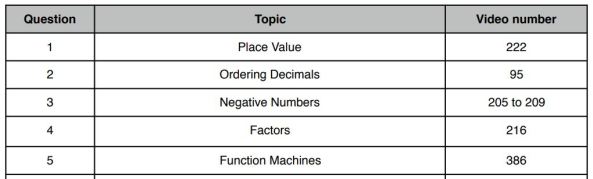
On Corbett Maths, try the Ultimate GCSE Revision Videos; use the GCSE Revision resources available for Edexcel, OCR, AQA, and CCEA, you will also find Revision checklists, a collection of Practice Papers, and A Bit of Everything Papers; the papers with questions provide very comprehensive syllabus coverage! Each paper includes a contents list with the relevant teaching video.
On 1st Class Maths, the Edexcel Revision page offers questions and solutions by topic and difficulty, note the final column in the table which shows the Edexcel past series percentage correct up to and including the June 2023 exams. The Ultimate Revision Booklets for Foundation (114 questions) and Higher (106 questions) have one question on every topic and accompanying video solutions. With similar resources, there is also an AQA Revision page.
It’s Barvember from White Rose Maths. Barvember, from White Rose Maths, was created to encourage the use of the bar model. Bar models can really help children visualise and then solve maths problems. You could solve the problems using this great digital tool from White Rose Maths, Bar Model.
Further resources on Bar Modelling:
For an Introduction to Bar Modelling have a look at the NCETM Secondary Professional Development Materials Choose the section on Using mathematical representations at KS3 for 10 different guidance documents including Bar Models. This 17-page document for professional development provides a very comprehensive introduction to Bar Modelling and includes example problems.
On the subject of White Rose Maths have a look at this brilliant resource from Ben Gordon: Representations through the Curriculum shows the progression of bar modelling from Year 7 to Year 11 with examples for each topic and some video support.
Thinking Blocks – Math Playground
The section on Further Resources in the NCETM guidance document includes Thinking Blocks, an outstanding resource that I included in a post on Ratio and Proportion. The relevant information on using the resource is included for completeness in this post. Further resources for Bar Modelling are also given.
Models like this really help students to visualise problems. Note the numerous videos showing how to model problems (scroll down the page). You can use the Thinking Blocks Tool to model your own problems; watching the videos will help you learn to use the tool. There is a very clear help section also.
Thinking Blocks Modeling Tool
I have used the tool here to model a problem from Andy Lutwyche’s Clumsy Clive on Ratio resource.
Thinking Blocks Modeling Tool – use for your own problems
Note this post on PixiMaths. Many PixiMaths lessons demonstrate examples using the bar model
An introductory worksheet from the excellent Mathspad site here, scroll down to Using bar pictures to solve equations for a free resource.
From Future Learn, Presenting the Bar Model Method. Dr Bokhove presents a short introduction to the bar model and shows two concrete examples: one for the part-part-whole model and the other for the comparison model.
The start of November is a good time to remind readers of Wayne Chadburn’s monthly calendars. He writes these calendars to provide regular, varied practice – a little bit of maths each day. Three versions of each monthly calendar are available, Higher, Foundation Plus, and Foundation; answers are provided.
With November examinations fast approaching, a reminder that many useful revision resources are available in this collection.
Corbett Maths – Revision ResourcesCorbett Maths – A Bit of Everything practice papers
On Corbett Maths, try the Ultimate GCSE Revision Videos; use the GCSE Revision resources available for Edexcel, OCR, AQA, and CCEA, you will also find Revision checklists, a collection of Practice Papers, and A Bit of Everything Papers; the papers with questions provide very comprehensive syllabus coverage! Each paper includes a contents list with the relevant teaching video.
CorbettMaths revision checklist
On 1st Class Maths, the Edexcel Revision page offers questions and solutions by topic and difficulty, note the final column in the table which shows the Edexcel past series percentage correct up to and including the June 2023 exams. The Ultimate Revision Booklets for Foundation (114 questions) and Higher (106 questions) have one question on every topic and accompanying video solutions.
From Mr Neill, a brilliant resource, all Edexcel, AQA and OCR GCSE maths questions categorised by topic with answers from June 2017 to June 2022 (9-1), available all on pdf, PowerPoint or Promethean.
On ExamQ from Mr Watts you can quickly search for Edexcel Maths GCSE and A-Level exam questions. You can choose from GCSE Foundation or Higher, AS or A level, you can also select by exam series, paper, area and topic.
The interface is very clear indeed, easily display the questions or mark schemes.
Dr Austin Maths – Revision Grids
From DrAustin Maths under Revision look at the very useful revision grids.
On Mr Morely Maths you will find a wonderful collection of GCSE resources, including Video tutorials, worksheets to match, exam question packs with mark schemes, starters, full lessons, revision guides, CPD sessions and methods road maps.
Mr Morley Maths Revision Work Books
Note the Revision Work Books, these booklets contain at least one past paper question on every topic split into grades 1-3, 4-5 and 6-9. Each has a contents page with QR code links to relevant videos.
I do like these excellent revision guides – notes jotters to accompany the videos.
Mr Morely Maths
From White Rose Maths, GCSE Practice Papers (scroll down) for AQA, Edexcel and OCR. Whilst based on the November and June 2022 advance information these papers and mark schemes for all three boards and also the excellent pre-exam workshops provide very useful revision resources.
White Rose MathsThird Space Learning
From Third Space Learning, papers for AQA and Edexcel have been created for 2023 (OCR to follow).
From GCSE Maths Tutor we have practice papers and full video solutions available for Higher and Foundation tiers.
On BBC Bitesize you will find GCSE Maths – exam practice, 5 quizzes of 10 questions each, with fully worked solutions.
Also from Bitesize, try these GCSE maths – quick-fire quizzes, each quiz has 10 quick-fire questions that should take approximately 5-10 minutes to complete. You can take the quiz again and answer a new set of questions. The answers are all explained.
This Custom Starter from Transum, is one I have featured before, it allows teachers to select the number of questions and the topics to include; scroll down the page and choose the topics you want from the Concept Selection. It is possible to save a particular selection of topics as the URL for your selection will be generated. It is also possible to drag the panels so your questions are displayed in the desired order. The beginning of a lesson can be an ideal time to review previous learning.
On the subject of starters – short questions can make ideal revision starters – a reminder of some great resources:
Transum has an extensive library of self-checking exercises, so we could easily provide examples on inequalities for example. On Transum, there are several ways to search for resources, for example, try:
On TES, from SNO, this Excel spreadsheet generates an endless supply of 1 mark questions with the option to display the answers, making an ideal starter. Two versions are available, you can choose 5 or 10 questions to display.
We start every foundation lesson with a booklet of ten 1&2 mark questions, aimed at repetition. Builds up in difficulty in both calc & non-calc topics. 80 pages worth. Seems to help reduce errors at the start of papers. Feel free to take a look. https://t.co/qdPT8P7UDupic.twitter.com/v9U2fwyegM— Mr Kingsley (@KingsleyMaths) February 12, 2021
Edexcel’s Practice Papers include freely available Foundation Tier one mark questions. There are calculator and non-calculator paper questions and mark schemes from June 2017 through to June 2019 (non-calculator) and to November 2019 for the calculator questions.
I do like Wayne Chadburn’s monthly calendars that provide regular, varied practice – a little bit of maths each day. Calendars for the 2023-24 academic year are available here. Note the three versions including crossover questions (these appear on both Foundation and Higher papers so great practice for the more challenging Foundation questions), Foundation, Foundation plus and Higher; answers are provided.
From Jake Gordon, try his Skills grid creator– customise exactly as you want from 90 skills, and answers are included.
Jake Gordon – Skills Grid CreatorJake Gordon – Skills Grid Creator
On Jonathan Hall’s Test Maker on MathsBot we could create a test to test many of these skills. Choose the skills you want from the menu, the number of questions, and the initial and final difficulty of the questions on a scale of 1 to 10, also note the Paired Solutions option to show one example with an answer then one to try. An Answer Key is provided for any test you create.
MathsBot – Test Maker
We could also use the many brilliant GCSE resources from MathsBot.
See on Maths White Board: Revision Board – generate a starter based on the Advance Information
Interactive Maths Generators – Dan Rodriguez-Clark
On Interactive Maths Generators from Dan Rodriguez-Clark (@InteractMaths), design your own sets of questions on more than 50 maths topics for your students to practice a variety of skills. There are many customisation options, generally as well as for individual topics. Full instructions are on Dan’s site.
This post on Knowledge Organisers is very popular – this has now been reorganised so that organisers for KS3, GCSE and A Level can easily be located. Do have a look at this post on Knowledge Organisers from Durrington Research School, it is not about the knowledge organisers themselves but how they are used for planning, teaching and testing. Note the example shared of a Maths Knowledge Organiser, Year 10 Expressions, Foundation. I like the fact that key vocabulary is included here, the few key facts needed and of course by far the largest section – key concepts with examples.
Mrs D has now completed her excellent set of Year 2 Pure Mathematics Organisers, these are clearly indexed in the A Level section where you can also find Pure Year 1, Statistics and Mechanics Knowledge Organisers.