Number Operations

Manipulation

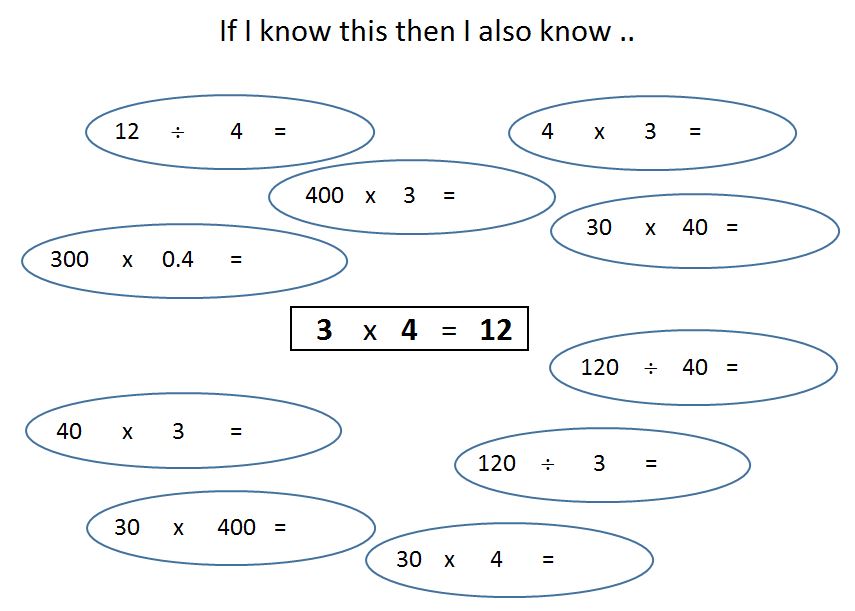
Questions such as this can make a great starter for a lesson and provide the chance to discuss number operations and the relationships between them. Manipulating numbers like this can also help with algebraic manipulation.

Looking for some more examples of this type, I came across a really useful resource on TES, “If I know this then I also know …” by Piers Butler. This would make an ideal lesson starter. As it is an Excel spreadsheet, I thought it would be simple to add another worksheet with the answers and created the Excel file CY If_I_know_this_then_I_also_know_ which is a copy of the original, but just adds another worksheet with the answers.

Thank you, Piers!

If I know this..

Standard Form Resources

Some resources for standard form:

I have been interested in Astronomy since discovering Patrick Moore’s books in the library as a child so enjoyed Richard Byrne’s post on resources to help students understand the size of the universe, I particularly like 100,000 Stars, a visualization of the 100,000 stars closest to Earth. All those lovely big numbers in Astronomy are excellent for teaching Standard Form; I wrote some time ago on the excellent mathematics resources available from NASA, see this on Scientific notation for example.

Staying with Astronomy, the Royal Observatory, Greenwich has some outstanding resources on TES, including Scales of the Universe (KS4 – age 14-16)

From the excellent Standards Unit, N4 on Estimating Length Using Standard Form works very well as a class activity. (You can find all the Standards Unit Resources here).

From Nrich, two activities on Standard Form.

Teachit Maths though a subscription site offers its entire collection of activities as pdfs for  free. I have found many high quality resources here for all ages. – try these on Standard Form.

From TES Resources – an extensive collection of (free) Standard Form Resources, note the 5 star reviews for many resources.

For the start or end of a lesson (or any time!), you could try some Diagnostic questions on Standard Form. I created a Standard Form Quiz from these questions.

diagnosticquestions.com

diagnosticquestions.com

 (See these posts for more information on the excellent Diagnostic Questions site).

A site with plenty of big numbers is Is That A BIG NUMBER?

(Post on Is That A BIG NUMBER)is-that-a-big-numb8r

Students could be shown how to check their work on WolframAlpha
standard-form WolframAlpha syntax

and finally some more great links including some rather good animations:

Scale of the universe. 

Magnifying the Universe

Secret Worlds: The Universe Within

breathingearth.net

You can find lots of data with very large numbers using Gapminder

Staying with world statistics, you could try Jonny Griffiths’ World-wide Statistics task from his Making Statistics Vital. You could use the figures from his spreadsheet – write the numbers in Standard Form and explore some real world Statistics at the same time.

Some recent discoveries…

Jeffrey Ventrella’s Composite Number Tree

I was reminded this morning of why Twitter can be so useful – I usually check the latest #mathchat tweets and saw Richard Wade’s tweet with a link to the latest Teach Maths newsletter, on ‘Ten Great Ideas’. The first item includes this wonderful Composite Number Tree by Jeffrey Ventrella – I’m looking forward to trying that with students after half term. I think it would make a great starter. Students could work out themselves how the tree is being formed and comment on any patterns they notice. Also included in the first Newsletter item is the excellent Primitives application by Alec McEachran, I included this myself with some resources for looking at Prime Factors in an earlier post.

It’s a small world! I see the second item is on Craig Barton’s Web Whizz video on Teachmathematics. You can see all Craig’s videos here on TES Resources.

On WolframAlpha, if you query on a word you can see a word frequency history, see this on Mathematics for example (the history is based on a Google books sample of one million books). An opportunity for some cross curricular work perhaps?

WolframAlpha is still free to check working for as many queries as you want making it very useful for students but now step by step solutions are limited to three a day unless you sign up to WolframAlpha Pro, so choose your three carefully! The new style step by step solutions are clearly presented – see this integration by parts for example:

(See this page for WolframAlpha examples showing the syntax for many different queries. I have added a couple of new slideshows for older students recently, on Set Theory & Logic and Differential Equations).

I mentioned Numberplay from The New York Times in a recent post but it’s worth another mention, they have some excellent articles. (Note this is included on the Reading page).

Finally, still on the subject of reading, I enjoyed Andrew Old’s post on ‘What Ofsted Say They Want’. Just what is good teaching all about? This is so sensible!

For UK teachers I hope you enjoyed half term last week or like me are looking forward to a week off this coming week!

By Colleen Young • Posted in Number

Negative Numbers – Resources

Sometimes resources for younger students can be useful for lower secondary age students, see for example Mark Robinson’s Numberlines  from the old Ambleside Primary School site which includes an option to display a number line from -5 to 5.

For another excellent number line resource see J Barrett’s Numberline Jump Maker on ictgames.com. I often recommend that students sketch a number line to help with addition and subtraction problems and very clear resources like these can really help. Teacher Resources on Line includes a Big Number Line under Basic Materials for display on a classroom wall

Games can be an excellent way to practise with negative numbers see for example games such as Connect 3 from Nrich and Tic Tac Go, a Wisweb applet.

Further resources include exercises from Trinity School in Nottingham (under Number) and Interactive Resources from CIMT (see unit 3, 3.3 on Negative Numbers and Unit 15, 15.1 and 15.2 for operations with negative numbers in the tutorials section).

There are many excellent resources on TES, the resource collections includes a section on Topic Specials which includes 10 of my favourite resources on Negative Numbers.

Countdown

A game of Countdown is a great way to start or end a lesson.

You can download an excellent free program for the Numbers Game from Chris Farmer’s CSF Software site.

For a low-tech solution print out the Make a number puzzles with solutions from Brain Food.
For other number puzzles see the Number, one of the Puzzles and Games series of pages.

For a new challenge why not try Coundown with Fractions from Nrich? See also the Nrich Countdown collection.